If you’ve spent hours building a Custom GPT, refining the instructions, adding knowledge, testing responses, and figuring out exactly how it should help someone, you may be wondering what happens to all that work as the Custom GPT landscape changes.
Here’s the important part:
Your Custom GPT isn’t the real asset.
The useful thinking inside it is.
Your process. Your expertise. Your questions. Your decision-making. Your workflow. And, most importantly, the result you designed it to deliver.
That doesn’t have to disappear.
Instead of abandoning what you’ve already created, you can extract the strongest part of your GPT and turn it into a focused micro tool.
And you don’t need to build a giant software application to do it.
Your GPT Was the Container, Not the Product
Think about why someone would use your Custom GPT.
They probably didn’t wake up thinking:
“I really need to have a conversation with another chatbot today.”
They wanted a result.
Maybe your GPT helped them:
- Evaluate a product idea
- Improve an offer
- Create a marketing plan
- Analyze their content
- Choose between several options
- Build a checklist
- Develop a strategy
- Score something
- Create a personalized recommendation
- Work through a process you’ve developed
That’s the valuable part.
The GPT was simply the container you used to deliver that result.
Once you understand that distinction, you can start looking at your existing GPTs very differently.
Instead of asking:
“What am I going to do with this GPT?”
Ask:
“What useful process inside this GPT could become a standalone product?”
That’s a much better question.
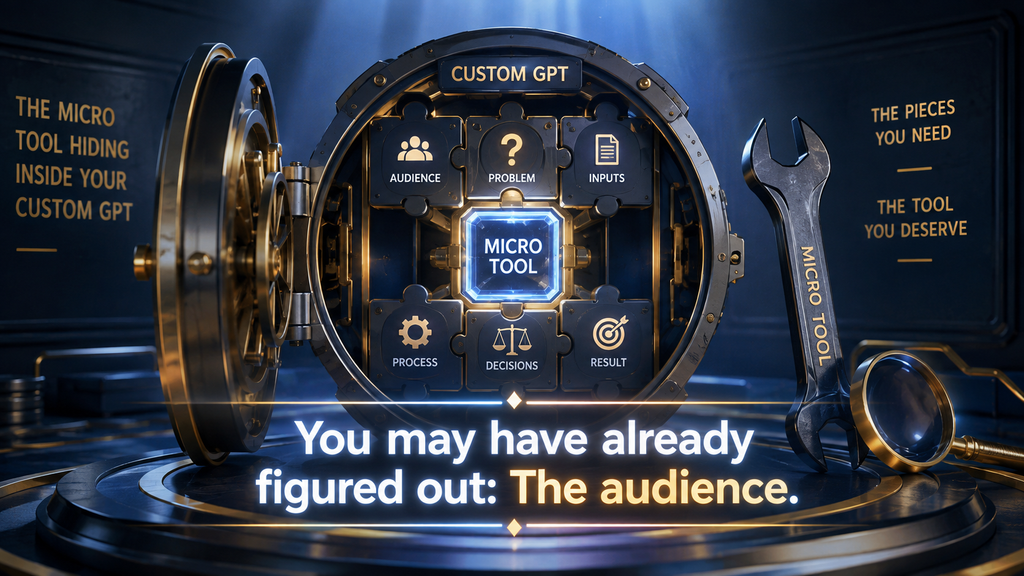
The Micro Tool Hiding Inside Your Custom GPT
A good Custom GPT often contains many of the pieces you need for a micro tool already.
You may have already figured out:
The audience.
Who is this supposed to help?
The problem.
What are they struggling with?
The inputs.
What information does the GPT need from them?
The process.
What does the GPT do with that information?
The decisions.
What does it evaluate, compare, calculate, prioritize, or recommend?
The result.
What should the user have when they’re finished?
Those pieces are incredibly useful when you start building a micro tool.
You aren’t necessarily starting from a blank page.
You’re reorganizing work you’ve already done into a different experience.
Start With Input → Process → Result
Here’s a simple exercise you can use with one of your Custom GPTs.
Forget about the technology for a minute.
Break your GPT into three pieces:
1. Input
What does your GPT need to know?
For example:
- Target audience
- Product idea
- Current offer
- Desired outcome
- Existing content
- Budget
- Experience level
- Preferences
- Goals
These could become fields, questions, selections, or choices inside your micro tool.
2. Process
Now ask what the GPT actually does with those answers.
Does it:
- Score something?
- Compare options?
- Identify problems?
- Recommend a direction?
- Organize information?
- Apply a framework?
- Prioritize actions?
- Generate a plan?
- Walk someone through a decision?
This is where much of your intellectual value lives.
3. Result
Finally, what should the user walk away with?
Maybe it’s:
- A score
- A recommendation
- An action plan
- A personalized checklist
- A roadmap
- A finished piece of content
- A prioritized list
- A decision
- A product concept
Put those pieces together:
INPUT → PROCESS → RESULT
Now you’re no longer just looking at a Custom GPT.
You’re looking at the foundation of a micro tool.
Don’t Convert Everything
Here’s where it’s easy to go wrong.
You look at your GPT and think:
“I need to turn every single thing this GPT can do into my new tool.”
You don’t.
In fact, doing that could make your first version harder to build and more confusing to use.
Instead, ask:
What is the ONE most useful job this GPT performs?
That’s the function I’d investigate first.
Suppose you built a GPT that helps people create digital products.
It might brainstorm ideas, evaluate markets, create names, suggest prices, write sales copy, develop bonuses, create emails, and generate social media posts.
That’s a lot.
Trying to convert all of it into one micro tool could create a monster.
Instead, maybe the strongest function is:
Helping someone determine whether their product idea is worth pursuing.
Now you have something focused.
The user enters the idea.
The tool asks several important questions.
It evaluates the answers.
It produces a score.
It identifies weaknesses.
Then it recommends what the creator should do next.
That’s a micro tool.
One problem. One guided process. One useful result.
A Micro Tool Doesn’t Need to Be SaaS
This is another place where creators can make things unnecessarily complicated.
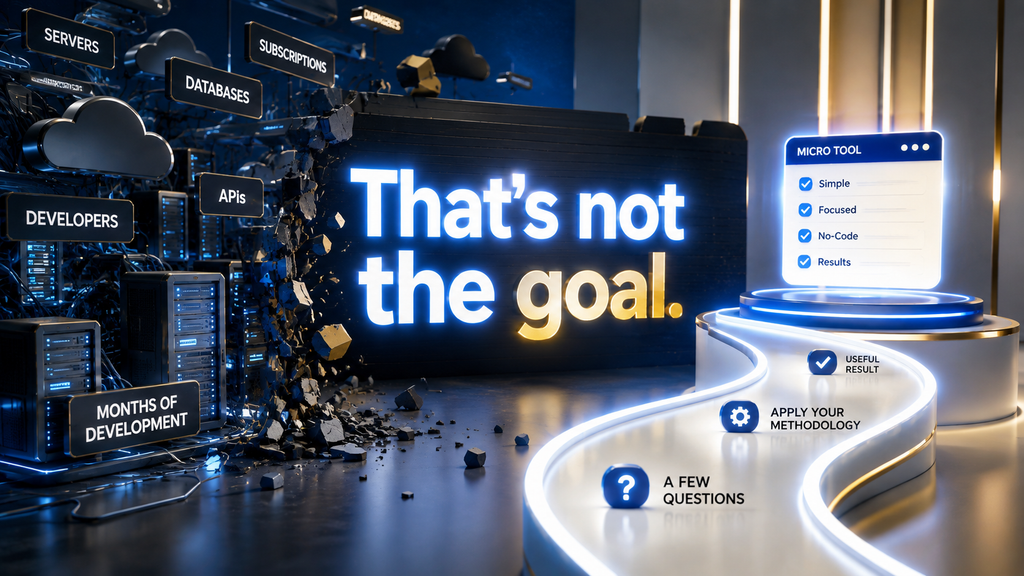
You hear “standalone tool” and immediately start imagining developers, servers, databases, subscriptions, APIs, and months of development.
That’s not the goal.
Micro tools are supposed to be micro.
A focused no-code micro tool might simply guide someone through a handful of questions, apply your methodology to their answers, and produce a useful result.
That’s enough.
You don’t need to recreate ChatGPT.
And you certainly don’t need to build every feature you can imagine.
Start with the smallest version capable of delivering the promised outcome.
You can always improve it later.
Think Guided Experience, Not Chatbot
There’s another important shift when moving from a Custom GPT to a micro tool.
With a GPT, the user often needs to figure out what to say.
They type something.
The GPT responds.
They ask something else.
The conversation continues.
That flexibility can be useful.
But it can also put work on the user.
A focused micro tool can provide more direction.
Instead of wondering what to type next, the user sees exactly what they need to do.
Step 1: Tell us about your idea.
Step 2: Choose your target customer.
Step 3: Identify the main problem.
Step 4: Select the desired outcome.
Step 5: Get your recommendation.
That’s a different experience.
The tool isn’t trying to have a conversation about everything.
It’s trying to get the user from Point A to Point B.
For beginning digital product creators, that clarity matters.
Your Old GPT Could Be a Product Idea Library
Here’s where this gets especially interesting.
If you’ve built multiple Custom GPTs, don’t look at them as a pile of old projects.
Look at them as a product idea library.
One GPT might contain a useful assessment.
Another might contain a scoring method.
Another might contain a planning framework.
Another might help someone make a decision.
Another might turn complicated information into a simple recommendation.
Any one of those functions could potentially become the foundation for an AI micro tool or no-code micro tool.
You may have already done more product development than you realize.
You just did it inside a different format.
Before You Build, Ask These Questions
Take one of your existing GPTs and answer these questions:
Who was this GPT built for?
What problem were they trying to solve?
What is the ONE most useful thing the GPT does?
What information does it need from the user?
What decisions does it make with that information?
What result does the user receive?
Could that process work as a guided experience instead of an open-ended conversation?
Would someone value that result enough to use—or potentially buy—the standalone tool?
If you can answer those questions clearly, you may already have the beginnings of your next product.
From Custom GPT to Micro Tool
The path doesn’t have to be complicated.
Think of it like this:
CUSTOM GPT
↓
Find the strongest function
↓
Identify the problem it solves
↓
Define the required inputs
↓
Extract the useful process
↓
Define one clear result
↓
Design the guided experience
↓
Build the simplest useful version
↓
Package it as a micro tool
You’re not throwing away your GPT.
You’re extracting the part worth keeping.
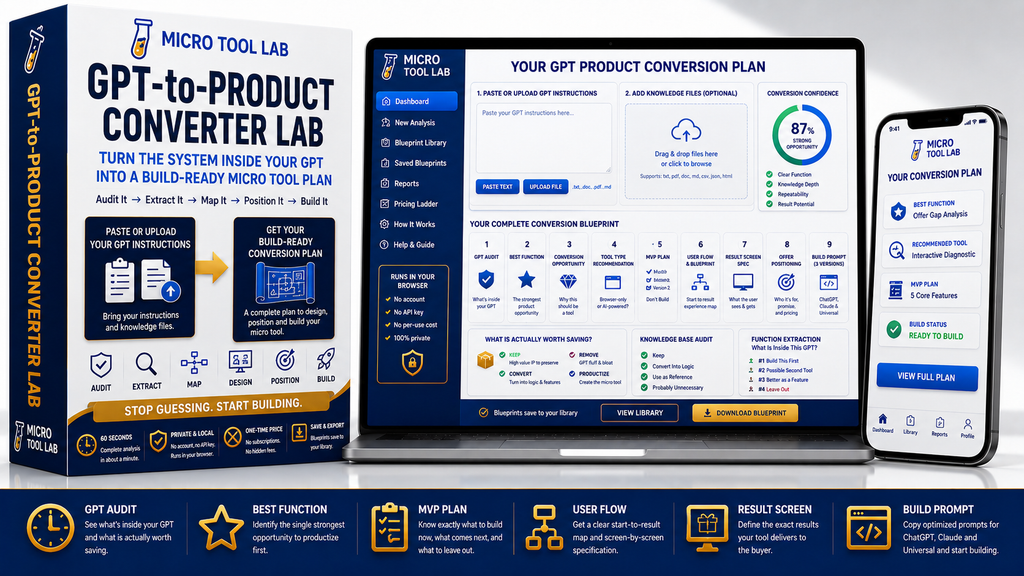
That’s Why I Built the GPT 2 Product Converter Lab
I built the GPT 2 Product Converter Lab for creators facing exactly this question:
“I’ve already built a Custom GPT. What could I turn it into?”
The Lab helps you look past the chatbot and identify the useful product hiding underneath it.
Instead of staring at your GPT and trying to figure everything out yourself, you work through the important conversion decisions:
What is its strongest function?
What problem is it really solving?
What should the standalone tool do?
What information should it collect?
What should the user experience look like?
What result should it deliver?
What belongs in the first version?
And what could this become as an actual digital product?
The goal isn’t to hand you another giant pile of ideas.
The goal is to help you leave with a practical direction for what to build next.
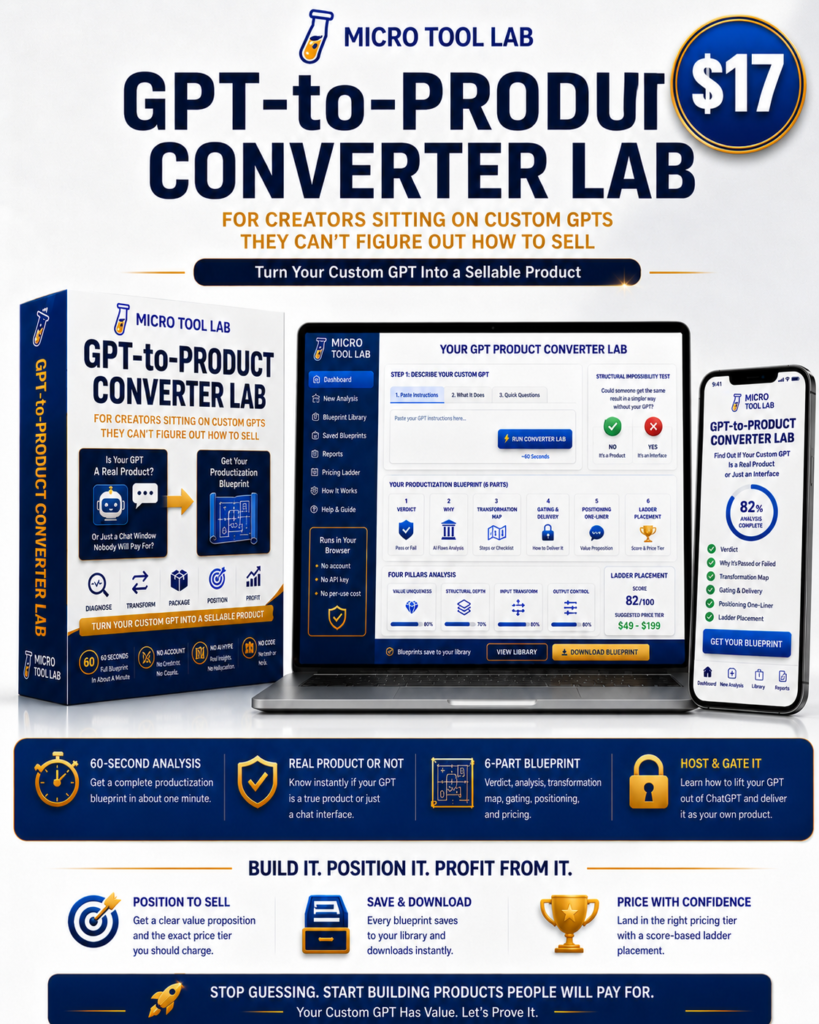
The GPT 2 Product Converter Lab is $17.
If you’ve already put time into building a Custom GPT, don’t automatically start over.
Extract the value. Keep the process. Build the next version.
Turn Your GPT Into a Micro Tool with the GPT 2 Product Converter Lab.
Discussion
Comments